
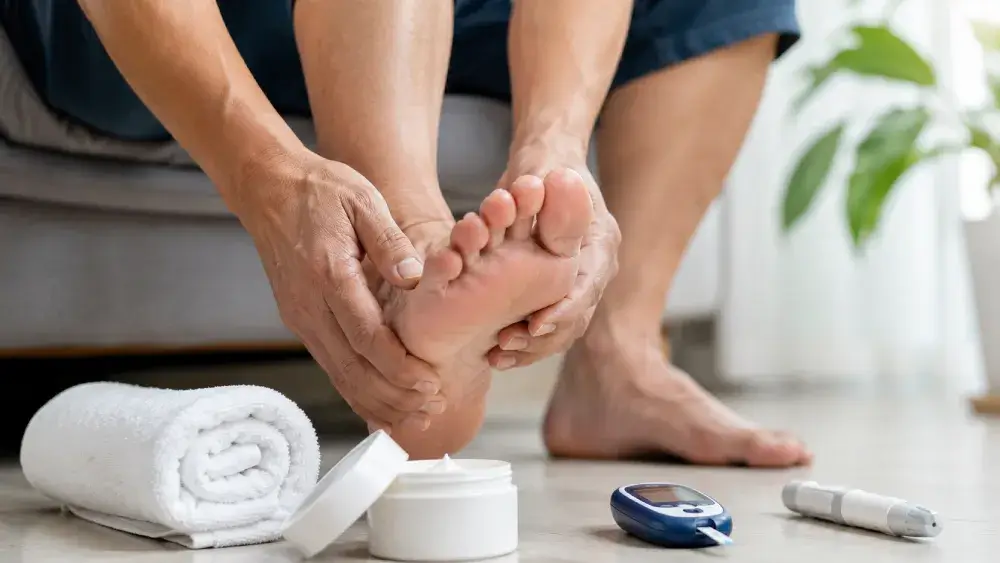
Why Diabetic Foot Problems Start Without Pain
Long-standing high blood sugar damages two things in the feet at once. It dulls the nerves, so an injury no longer hurts, and it narrows the arteries, so the injury heals slowly. A small blister from a new pair of shoes stops being a small blister and becomes an ulcer - and the first time many patients notice is when they see a stain on the sock.
That combination is why foot complications are the leading cause of non-traumatic amputation in India, and also why they are among the most preventable. Five minutes a day and the right footwear prevent the large majority of them.
The Five-Minute Daily Routine
Look, Every Single Day
Inspect both feet in good light - the tops, the soles, the heels and between every toe. Use a mirror on the floor or ask a family member if bending is difficult. You are looking for cuts, blisters, cracks, redness, swelling, colour change and anything that was not there yesterday.
Wash and Dry Properly
Wash daily with lukewarm water - test the temperature with your elbow or hand, never your feet, because numb feet cannot detect a scald. Dry thoroughly, particularly between the toes, where damp skin breaks down and fungal infection takes hold.
Moisturise, but Not Between the Toes
Apply a plain moisturiser to the tops and soles to prevent cracked heels, which are a common entry point for infection. Leave the skin between the toes dry.
Cut Nails Straight Across
Trim straight, not curved into the corners, and file the edges rather than cutting them down. Never use a blade, and never let anyone else dig at an ingrown nail. Corns and calluses must never be shaved at home or treated with corn caps - they need a podiatrist.
Check Inside Your Shoes
Run your hand through both shoes before wearing them. A small stone, a folded insole or a torn lining can cause a full-thickness wound in a single day on a numb foot.
Never Walk Barefoot
Not in the house, not in the temple, not in the bathroom. Hot floors, small stones and sharp edges cause injuries you will not feel. Keep a dedicated indoor pair of slippers.
Getting the Footwear Right
Footwear causes more diabetic foot wounds than any other single factor. Choose shoes with a deep, wide toe box, a soft upper without internal seams, a cushioned insole and a firm heel counter. Buy them in the evening, when feet are at their largest, and break new pairs in for an hour a day rather than wearing them all day at once. If you have already had an ulcer or have deformity such as clawed toes or a bunion, custom offloading insoles are not a luxury - they are the main thing preventing the next ulcer.
Warning Signs and How Fast to Act
Not every foot problem is an emergency, but on a diabetic foot the safe assumption is that things move quickly.
Swipe the table sideways to see all columns →
| What You Notice | What It May Mean | How Soon to Act |
|---|---|---|
| Redness, swelling or warmth in one foot | Early infection, or Charcot foot if there is no wound | Same day |
| Any open wound, blister or crack | Potential ulcer - do not wait to see if it heals | Same day |
| Discharge, foul smell or black tissue | Established infection or gangrene | Emergency - go now |
| New numbness, burning or tingling | Progressing neuropathy | Within a week |
| Cramping calf pain on walking that eases at rest | Reduced arterial blood supply | Within a week |
| Thick callus, corn or ingrown nail | High-pressure point that often precedes an ulcer | Book a podiatry review - never treat at home |
Fever, uncontrolled sugars alongside a foot wound, or redness spreading up the leg means the same day, not the next appointment.
What the Annual Foot Check Involves
Everyone with diabetes needs a formal foot assessment at least once a year, and more often if risk is raised. It takes a few minutes and covers protective sensation with a monofilament and tuning fork, foot pulses and where needed an ankle-brachial index, skin and nail condition, and the shape of the foot - deformity, clawing and pressure points. From these we assign a risk category, which determines how often you are seen and whether you need custom insoles. Our diabetic foot care service covers all of it, and works alongside your diabetes care reviews.
Key Points to Remember
- Numbness is not protection - it is the reason injuries go unnoticed until they are serious.
- Look at your feet every day, including between the toes and the soles.
- Never walk barefoot, and always check inside shoes before putting them on.
- Corns, calluses and ingrown nails are professional jobs, never home ones.
- Any new wound, redness or swelling needs review the same day - waiting a week is what turns an ulcer into an amputation.
When to See a Diabetologist
Book a review if you have never had a formal foot assessment, if you have lost sensation or developed burning pain, if you have a wound that has not healed within a few days, if calluses keep returning at the same spot, or if you have had a previous ulcer or amputation. Good glucose control, blood pressure and cholesterol management protect the nerves and arteries that keep the feet safe.
Conclusion
Almost every serious diabetic foot problem starts as something small, painless and easily missed. The routine that prevents it is genuinely five minutes long - look, wash, dry, moisturise, check the shoes.
Combine that with proper footwear, an annual professional foot check and same-day attention to anything new, and the risk of ever reaching an ulcer becomes very small.
FAQs
Yes, most do when they are caught early, offloaded properly and the blood supply is adequate. Healing depends far more on taking pressure off the wound and controlling infection than on any particular dressing.
Only at a place that sterilises instruments and only if you tell them you have diabetes. No cutting of cuticles or calluses, and no blades. If you have numbness or poor circulation, a podiatrist is the safer option.
That is usually diabetic neuropathy, and it is often worse at night. Improving glucose control slows its progression, and specific medication can relieve the pain. Vitamin B12 and thyroid levels should also be checked.
No. Soaking softens and breaks down the skin, and numb feet cannot judge temperature, so scalds are common. Wash with lukewarm water and dry properly instead.
At least once a year for everyone with diabetes. Every three to six months if you have neuropathy, poor circulation or foot deformity, and more frequently still if you have had a previous ulcer.

Dr. K.S. Ranganayakulu
Consultant Diabetologist & Endocrinologist, MRCP (London), CCT (UK). 22 years across the NHS and India, now practising at KIMS Hospitals (morning) & True Med Diagnostics & Clinics (evening & Sunday), Kondapur, Hyderabad. Read full profile →